Thursday, March 08, 2012

Thoughts on Roald Dahl – and Commemorative Stamps

The Royal Mail is issuing these charming Roald Dahl stamps, featuring the original Quentin Blake illustrations. I'm not a stamp collector, but I would willingly snap up this literary keepsake in a heartbeat! Aren't they adorable?

Seeing these has reminded me how much I loved reading Roald Dahl novels as a child. Charlie and the Chocolate Factory, Charlie and the Great Glass Elevator, James and the Giant Peach: these stories delighted my young imagination. Unfortunately I never read Matilda, but I have a feeling it would still be magical reading for adults -- particularly an adult like me who adores children's literature.

My favourite Dahl narrative would have to be Fantastic Mr. Fox. Though it's quite short and aimed at early readers, I wasn't introduced to this charming story until I was ten. Luckily, my fourth grade teacher firmly believed one should never 'outgrow' children's books and happily passed it on to my class. I was immediately drawn in by the cunning of Mr. Fox and the grotesque habits of the three farmers who attempt to put a stop to Mr. Fox's habitual pilfering of their resources. I still recall the rhyme about these unhygienic farmers:

Boggis and Bunce and Bean
One short, one fat, one lean.
These horrible crooks
So different in looks
Were nonetheless equally mean. 


I always recommend this humorous tale to my friends with children and often give it as a gift. This story, as is generally the case with Dahl's work, possesses a magic that has to be shared.

Did you read Roald Dahl novels when you were young? Which was your favourite?

P.S. Wes Anderson's adaptation of Fantastic Mr. Fox is, well, fantastic -- for adults and children. Since the source material is brief, I forgive the liberties he takes with the text. You can watch the trailer here.

Wednesday, March 07, 2012

Judging a Book by Its Cover, A Top Ten Tuesday Post


I'm a bit late to the game on this one, but Jillian's post has inspired me to join this week's Top Ten Tuesday event hosted by The Broke and the Boookish. So I'm sharing my top ten favourite book covers, united by a theme of my choosing. This topic ties in perfectly with some thoughts I've been having recently about the old adage 'don't judge a book by its cover.'

I do just that and more often than I'd like to admit. I can't count how many times I've purchased a book simply because 'it's pretty' -- pretty being my adjective of choice when I impulsively splurge on yet another book I can't afford. This practice isn't always to my benefit. Sometimes I toss a 'pretty book' to the side after reading, realizing I've been the dupe of a clever design and marketing strategy.

Sometimes I get lucky.

Once upon a time, I had no intention of reading more of Charles Dickens's novels. My horrid remembrances of having Great Expectations forced upon me in middle school put me off him for good. Then these gorgeous clothbound editions of Penguin classics suddenly popped up on the shelves of the bookstore where I worked. This book lover was entranced by Coralie Bickford-Smith's stunning designs. I walked by that beautiful copy of Great Expectations, the very book I loathed beyond description, day after day. It called out to me every time I passed by, begging to be chosen. Finally, I caved and bought the damn thing -- it was just so pretty. (Are you noticing a trend with the pretty?)

Maybe, I thought, Dickens isn't so bad after all. Maybe I've misjudged him. While I thought about it, I picked up the clothbound Oliver Twist to accompany its Dickensian sibling. Just in case.

As the abundance of Dickens-themed posts on this blog will testify, I grew to love the author I previously despised. I credit Coralie Bickford-Smith with igniting that gradual change of heart. It was her 'pretty' book that urged me to give Dickens another chance. In honor of her influence on my reading habits, I would like to share ten of my favourite classic designs by Coralie Bickford-Smith. I own several of the series now and have every intention of adding to my collection.


I love the chandeliers on this cover of Great Expectations. The designs created for Charles Dickens texts are particular stellar.


The pocket watch, which Oliver is taught to steal under the tutelage of the Artful Dodger and the rest of Fagin's gang, seems like the perfect image to represent this novel. I'm admire all of the designs in this series, but Oliver Twist might be my favourite of the bunch.


The image of the birdcage is such a potent one in Bleak House. Miss Flite owns a menagerie of birds, whom she says will be released on the day of judgement. It also, I think, serves as an effective symbol for the ways in which various characters of the novel metaphorically cage themsleves to a limited existence through their obsessions with the case of Jarndyce and Jarndyce.


The knitting needles, I presume, are a direct reference to Madame Defarge. She has the stillness of the lion before it strikes. Her eerie calm, as she quietly sits knitting, presages the violent outbursts that occur later in the novel. She is a standout character in the fantastic A Tale of Two Cities. Indeed, Madame Defarge is one of my favourite characters in the whole of Dickens's oeuvre.


I'd been lusting after this edition of George Eliot's Middlemarch for months when my dear friend Liz gave it to me as a parting gift before I left England. Therefore, this design has a lovely sentimental value for me.


Clothbound editions of all Jane Austen's completed novels have been released. The intricacy of this design for Pride and Prejudice makes it, in my opinion, the best of the six.


Illustrating the flamingos who have day jobs as croquet mallets in Lewis Carroll's Alice's Adventures in Wonderland is pure brilliance. I love the bright-pink-on-white color scheme.


The peacock feather motif on this cover of The Picture of Dorian Gray by Oscar Wilde is simply gorgeous.


The design of Emily's Wuthering Heights is another favourite of mine, probably because the image of the rose illustrates the relationship between Cathy and Heathcliff nicely. It's beautiful but full of thorns. If Cathy and Heathcliff aren't prickly, I don't know who in fiction is.


And finally...Charlotte's Jane Eyre. I have a soft spot for this cover, because Jane Eyre may possibly be my favourite novel of all time. Also, it's red, a color that makes everything vibrant.


Penguin hosted a live web chat with Coralie Bickford-Smith a few months ago, and she kindly answered my question about the extent to which the narratives of the novels influence her designs. It was fascinating to hear about the creative process behind this aesthetic series. Here is her reply:

I try to read all the books I design covers for but sometimes (due to time constraints) it is just not possible and I go to the blurbs team for a chat to bounce ideas off. For me the narrative influences my creative process massively. For the hardback classics some of the final patterns are more literal than others. The peacock feather on Dorian Grey, for example, plays on the book’s themes of vanity and the superficial, whereas the leaf motif on Jane Eyre, refers directly to the lightning-blasted chestnut tree, a concrete element in the text that serves as a potent symbol of the book’s central relationship.

So, buying books simply because they would look dashing on my shelves does occasionally lead me astray. Yet it has also opened my eyes to fabulous books I wouldn't otherwise have read and helped me to reconsider my opinions on literature. Judging a book by its cover is a practice I'll happily continue.

Do you ever embrace or reject books simply because of their covers? I'd love to hear! 

Monday, March 05, 2012

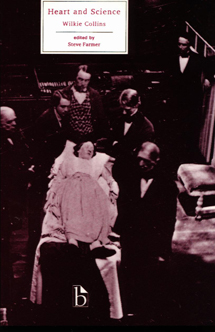
Heart and Science by Wilkie Collins


Heart and Science is my first experience with Wilkie Collins. As a Victorianist, I've been meaning to familiarize myself with this key novelist of the period for some time. Collins is well known for his novels The Woman in White and The Moonstone, where I originally meant to start, but the illustration of Victorian scientific debates in Heart and Science quickly drew my attention. I actually began this novel ages ago (and briefly commented on it in a previous post), but the expiration of my university library privileges meant that I was forced to return the book partially read. Luckily, I was able to acquire a copy from another library, finally allowing me to see this intriguing plot to the end.

The novel revolves around the recently orphaned Carmina Graywell. Raised in Italy, she returns to England where she will be under of the guardianship of her paternal aunt Mrs. Gallilee. Ovid Vere, Mrs. Gallilee's son by a previous marriage, immediately falls in love with his benevolent cousin and the two quickly become engaged. Unbeknownst to Ovid or Carmina, Mrs. Gallilee is on the brink of financial ruin. Dependent on the vast sum of money that is allocated to her while Carmina remains under her care, she maliciously resolves to tear the pair apart through manipulative methods of subterfuge in order to retain access to Carmina's inheritance.

Knowing that the bulk of Wilkie Collins texts are classified as sensation fiction, I was expecting the plot to be more...well, blatantly sensational. True, there are faintings fits and bouts of madness galore. But for the most part, the conflicts between the characters are fought through subtextuality. Mrs. Gallilee will tell the family's governess Miss Minerva A, by which she really means B. Miss Minerva, realizing that Mrs. Gallilee is hinting at B though she says A, will respond with C, by which she really means D. It can render passages of dialogue a bit confusing at times, but the manifestation of such passive-aggressive tension is also very interesting for the reader.

Wilkie Collins

Because Wilkie Collins and Charles Dickens were great friends and colleagues, I idly wondered before diving into Heart and Science if Collins's representation of women would coincide with that of his BFF. As I've expressed before, Dickens's heroines aren't the multi-faceted women I would like to see in fiction. Rather, many of them (e.g., Lucy Manette in A Tale of Two Cities) seem to be an incarnation of his angel-of-the-house fantasy. I'm happy to report that Carmina Graywell didn't fall into that category for me. She is unbelievably kind, continually placing a faith in others that could be foolhardy but instead wins her friends wherever she goes. When the situation calls for it, however, she stands up for herself. She defies Mrs. Gallilee in spite of the threats her aunt employs in an effort to subdue her. But Carmina won't be subdued. She is an illustration of how a Victorian heroine can be traditionally feminine yet strong.

As I mentioned above, I was initially drawn to Heart and Science for its engagement with Victorian science. Vivisection, experimentation on living animals, was widely practiced and hotly debated at the time. Dr. Benjulia, a friend of Mrs. Gallilee's, becomes interested in family affairs as a result of his fixation on brain disease. He also secretly practices vivisection in his laboratory, hoarding an array of unfortunate animals for the purpose. Chapter 32 is a discussion of vivisection, in which Collins carefully inserts many of the arguments against this cruel practice. Benjulia's words on the subject, and why he chooses to indulge in vivisection, are chilling:

Have I no feeling, as you call it? My last experiments on a monkey horrified me. His cries of suffering, his gestures of entreaty, were like the cries and gestures of a child. I would have given the world to put him out of his misery. But I went on. In the glorious cause I went on. My hands turned cold -- my heart ached -- I thought of a child I sometimes play with -- I suffered -- I resisted -- I went on. All for Knowledge! all for Knowledge! (p. 191)

I loved the exploration, one still relevant today, of what we are willing to sacrifice for the advancement of science and technology. Are we paying too great a price?

These analyses aside, Heart and Science is a fast-paced, enjoyable read. It left me eager to explore more of Wilkie Collins's texts as well as sensation fiction by female authors, namely Lady Audley's Secret by Mary Elizabeth Braddon and East Lynne by Ellen Wood. I'm interested to see how the genre is represented by women. Are the generic trends essentially the same, or do they differ based on the gender of the author? If you've read them, I'd love to hear what you think as well as any sensation fiction recommendations!

Sunday, March 04, 2012

Charles Dickens on the Runway


One side effect of my fixed status as a bookworm is the absolute delight I feel when classic literature seeps into contemporary culture. Whether it's manifested through kitschy comics or Colin Firth in a wet shirt, I find it comforting to know that the literary works I hold so dear still influence the world today. I was, therefore, thrilled to come across this article which charts the marked Charles Dickens inspiration on this season's runway. The photos below highlight a few of my favourite Dickensian-styled pieces.

Left: Prabal Gurung; Right: Marchesa

According to the article, the designers responsible for these looks cited Miss Havisham from Great Expectations as the muse for their collections. Both convey the whimsicality that I associate with Dickens's eternal bride-to-be. The girl on the right, in particular, is Victorian bridal meets twenty-first century. I love that lace!


I would sport a ready-to-wear version of these ensembles in a hearbeat! The velvet waistcoat and overcoat with floral ascot and tailored skirt won me over at first glance. It's like a female-friendly revision of the Victorian chap.

Does your taste in literature influence your taste in fashion? I, for one, have been dreaming of an empire-waist, Austen-inspired wedding dress since I was fifteen!

Friday, March 02, 2012

Brontë News and Other Distractions

My beloved Charlotte

As of late, I've been keeping myself busy with numerous applications. Revising writing, whipping up CVs, filling out form after form: it's been quite the process. Throughout I've received good news and frustrating news, and there is much more of it to come. I tend to take the bad news to heart, so I'm trying to keep faith as I complete yet another application that all will turn out as it should. The down side to all of this is that it's kept me from writing the posts I was hoping to get up this week. I've read some fantastic literature lately, my thoughts on which I'm dying to share, not to mention that Dickensian literary pilgrimage I have yet to fully document. These will keep until my days become less hectic.

Perhaps the most exciting news this week for a Victorian geek like me is the revelation that a piece of lost writing by Charlotte Brontë has recently been discovered. 'L'Ingratitude' -- apparently filled with inconsistencies in French grammar -- is now the earliest instance we have on record of the homework assigned to her by Constantin Heger, the professor with whom Charlotte fell desperately in love. Although he was married, Charlotte sent him numerous love letters, much to the chagrin of his wife. This episode in Charlotte's life led some fellow MA students and I to coin the name of a new disease: Charlotte Brontë Syndrome. CBS, as it is commonly referred to, is a condition in which the patient suffers from an acute and unrealistic attachment to a tutor or mentor, usually of the academic variety. Symptoms include emotional outbursts and inappropriate revelations. And guys, it's totally a real disease. 

But I digress.

It thrills me to no end that lost manuscripts by beloved authors are still being discovered. Can you imagine stumbling upon one, hidden amongst that junk in the attic? I would love to find that lost novel Emily supposedly wrote or a forgotten novel by Jane Austen. At this point, such revelations are unlikely, but a reader can dream, right? Which author's work do you secretly hope we find more of? I would love to hear!

Sunday, February 26, 2012

Oscar Night


As a movie buff, I generally look forward to the Academy Awards. There are movies I root for and movies that I hope crash and burn (I won't name names, but...[cough] Avatar). There are speeches that makes me laugh and cry and speeches that successfully put me to sleep in record time. Oh, and I love passing judgment on the endless parade of dresses -- the good, the bad and the ugly.

This year we're watching the epic-length show with an Oscar Party. I'll be cheering on The Artist, Midnight in Paris, and the ladies from The Help over an abundance of food. Chatting with friends and family during the boring bits will hopefully keep me conscious during the lengthy ceremony. Will you be watching? Which films/actors would you like to see awarded the Golden Statue?

P.S. Thank you for your excellent Edith Wharton recommendations. The House of Mirth was the clear winner, so I'll shortly be digging into it for my first Wharton experience!

Friday, February 24, 2012

Edith Wharton


Confession: I don't like American literature. I just don't. Not being a great fan of American classics, I've largely avoided interaction with many of the nation's celebrated writers. John Steinbeck, Ernest Hemingway, Mark Twain: overrated. All of them. As an American, I'm aware I am not exhibiting much patriotism in my indifference (even extreme dislike) of my country's canon, but there it is. I honestly have never regretted migrating to England for my education in order to focus on British texts.

However...

Lately I've felt like I'm missing out by excluding Edith Wharton from my library. I've not read a single work of hers, and I'd like to change that. A friend has been consistently encouraging me to give The Age of Innocence a go, then I'll come across an enthusiastic review of Ethan Frome. While I'm currently (and quite happily) buried under a pile of books all vying for my attention, my thoughts keep wandering to Edith Wharton. Clearly my literary subconscious is dying to get to know her, and I need to arrange a meeting soon.

So, as one who is entirely ignorant of this acclaimed author, I'd love to hear your thoughts on the subject and as well as any recommendations. I'm inclined to begin my Edith Wharton education with The Age of Innocence, but I can't be sure. Where would you start?  Do you have a favourite Wharton text? What is it about her writing that you like if, indeed, you like it at all. Please, educate me!

P.S. Even though I've not read a word of Edith Wharton's, I am dying to visit her former home and museum The Mount. Methinks I see another literary pilgrimage on the horizon. Check it out:


Friday, February 17, 2012

Literary Love: Favourite Fictional Couples

The story that started it all...

Ever since I read Jane Austen's quintessential tale of Regency courtship Pride and Prejudice during my teenage years I have been fairly obsessed with classic love stories. Elizabeth Bennet and Mr. Darcy started a habit that has continued well into adulthood -- nor does it show any signs of abating in the future. In honour of Valentine's Day, I would like to share a list of the beloved couples that comprise my favourite narratives. These appear in no particular order, because I didn't think I could bear the stress of ranking them in addition to narrowing the list down to one (long) post...

 Anne Shirley and Gilbert Blythe


From the moment he called her carrots I was hooked! When he told her, on what seemed to be his deathbed, that 'there would never be anyone for me but you' I was a goner. A favourite of mine from my days in high school, I'm still quite taken with Anne's overactive imagination.

Bridget Jones and Mark Darcy


I'm generally not a fan of Jane Austen sequels, modernizations and what not, but I have to make an exception for Helen Fielding's Bridget Jone's Diary. I relate to Bridget because she's an older single woman who is reminded of her marital status on an annoyingly regular basis, and she constantly puts her foot in her mouth. I often say the most thoughtless things, only I can't attribute it to inebriation like Bridget does. If Ms. Jones managed to snag herself a Darcy, then there's hope for the rest of us awkward single girls, right?

Helen Huntingdon and Gilbert Markham


The inclusion of this pair from Anne's The Tenant of Wildfell Hall may spark controversy. I know many who maintain that Gilbert is a bit dumb and Helen, therefore, deserves better. But I love that Gilbert can see Helen is outspoken, independent and far more intelligent than he is -- yet he's not intimidated by it. That's rather forward thinking on Anne's part. When Helen and Gilbert undergo a separation midway through the novel, I was so moved I cried to the point where I could no longer see the page.

Margaret Hale and John Thornton


Oh, the tension! The tension between these two in Elizabeth Gaskell's North and South is so palpable you could cut it with a knife, proverbially speaking. Watching Margaret and Mr. Thornton overcome preconceptions and misunderstandings (much like Darcy and Elizabeth) as they slowly come together is a complete joy! Thornton gets bonus points for carrying around a flower from Margaret's childhood home. I know some were disappointed when the book didn't have the epic kiss the adaptation portrays. If you look closely at the final pages of the novel, it's there. What else could Gaskell have meant by 'some time of delicious silence'? I ask you!

Margeurite St. Just and Sir Percival Blakeney, Baronet


They seek him here, they seek him there. I certainly did seek him everywhere, rabidly consuming the novel, the film and the musical. Set against the dramatic events of the French Revolution, I almost wished I was a French aristocrat at risk of losing her head -- just so I could have the privilege of being rescued by the enigmatic Sir Percy. Instead, I named my dog after him. 

Beatrice and Benedick


The witty banter of this dynamic duo has officially made Much Ado About Nothing my favourite Shakespeare play. This is quite a distinction, because anyone who's anyone knows that choosing a favourite Shakespeare play is virtually impossible. In addition to the comical, playful insults they pass back and forth at lightning speed, these two also have their sweet moments. Refer, for instance, to the line in which Benedick first confesses his love for Beatrice: 'I do love nothing in the world so well as you: is that not strange?'

Anne Elliot and Captain Wentworth


As much as I adore my beloved P&P, there's something about the quiet maturity of Persuasion that makes Jane Austen's final novel utterly enchanting. I love the way Anne blossoms before the reader's eyes, the poignant discussion of constancy in relationships, how Wentworth notices and appreciates our heroine in a way no other character does and the theme of getting a second chance at love. Captain Wentworth, for the record, writes what is possibly the best letter in literary history. 'You pierce my soul.' How can that be beaten? If by chance you are unacquainted with this wondrous epistle, do yourself a favour and read it now. You may want to read it sitting down though. I myself some women have been known to swoon.

Jane Eyre and Edward Rochester


Again, this can be seen a controversial choice. I'm sorry Heathcliff fans, but Rochester is the clear winner for me. As I have remarked before, Rochester would not kill my dog. Percy wouldn't fare so well as the hands of Heathcliff. But seriously, this novel kills me. I reread the good bits all the time once in a blue moon. The passion, the celestial telegrams, Rochester's attempted seduction, their eventual reunion, the brilliant simplicity of 'Reader, I married him.' I. Can't. Get. Enough. I don't even mind that he has a wife hidden in the attic. Observe the following passage where Rochester is speaking to Jane (p. 291 of the Penguin edition):

I sometimes have a queer feeling with regard to you -- especially when you are near me, as now: it is as if I had a string somewhere under my left ribs, tightly and inextricably knotted to a similar string situated in the corresponding quarter of your little frame. And if that boisterous Channel, and two hundred miles or so of land come broad between us, I am afraid that cord of communion will be snapped; and then I've a nervous notion I should take to bleeding inwardly.

How can that not win a reader over? I ask you!

And while this last selection isn't a literary couple, I had to give a little shout out to...

The Ladies of Cranford


I love that Elizabeth Gaskell's Cranford validates the lives of Spinsters, particularly since nineteenth-century society consistently exhibited a propensity to write these women off. Masked behind an amusing veneer of Victorian propriety, these ladies are unbelievably kind and loving. Watching them take care of one another (even at great personal cost) moves me to tears. That's love.

Wednesday, February 15, 2012

It's a Readathon...

A Young Girl Reading -- Fragonard (1776)

Cassandra over at Literary Stars is hosting a readathon this coming weekend, taking place on Saturday and Sunday (the 18th and 19th)! She's eager to celebrate her end of term in true literary fashion, and I am eager for any excuse to read for lengthy periods of time. I'm not sure what I'll be digging into just yet (Charles Dickens? Wilkie Collins? Non-fiction?), but I'll be updating this post throughout the event to let everybody know what I'm reading and the progressing I'm making. It probably won't be much -- I generally read at a tortoise's pace -- but I'm looking forward to a literary weekend. If you anticipate having some free time over the coming days, please join in here. Happy Reading!


Readathon status updates appear after the jump...

Tuesday, February 14, 2012

Happy Valentine's Day!


I used to loathe Valentine's Day. I saw it as a pink and red assault on singletons the world over. It took years before I fully realized that whether I'm in a romantic relationship or not, I am surrounded by people whom I dearly love. That's always something to celebrate. Obviously we should express our appreciation for the those who enrich our lives throughout the year. Still, it's nice to have a holiday dedicated to the purpose. It serves as a reminder to not take the love given to us for granted. So, I would like to thank the friends and family members who infuse my days with their warmth and humour. You make my life a joy and I love you for it! Happy Valentine's Day!


The above is my attempt at creating Valentines of the edible variety. Sadly, the recipe I used was not a good one, and the sugar cookies I meant to make came out like crumbly shortbread biscuits that are begging for more butter. At least they're pretty, right?

P.S. In honour of V-Day I'll be writing a post about my favourite literary couples. First, however, I must pare down my epic-length list into something that will accommodate a single blog entry. I won't lie, this will be tricky. :)