Showing posts with label Wilkie Collins. Show all posts
Tuesday, April 03, 2012
The Woman in White Readalong
I've barely made a dent in my spring reading plans. Life has got in the way, cruelly pushing literary perusal to the back burner. And yet...
I just can't resist joining in The Woman in White Readalong hosted by Reading Rambo. This wildly popular sensation novel is calling me, and I find myself headed towards the proverbial white light. Joining the cyber-discussion of Wilkie Collins's most beloved text will be great fun, and the month-long schedule will still allow me to progress with my spring reading plans. Perfect!
To kick off the event, bloggers are meant to share their preconceptions about The Woman in White and its author. I probably know a bit more about this 1859 novel than many of the participants, because I've started it twice before and [gasp] never finished it. On my second attempt I was approaching the halfway point before jumping ship. Oh, the shame!
I wouldn't wish anybody to attribute my inattention to Collins's writing. In fact, on both occasions I found the The Woman in White to be intriguing and engaging, and on both occasions the multiple distractions of daily life managed to interrupt my experience. This time, however, I'm determined to succeed!
The readalong has come at an opportune time, because Wilkie Collins has been on this reader's mind quite a bit in recent months. The bohemian lifestyle of this benchmark Victorian writer (a great friend of Charles Dickens) has been a fascinating topic of research. I recently posted about how Collins secretly maintained relationships with two women under separate households. Coincidentally, the bigamy plot permeated the sensation genre for which Collins became famous, though I haven't seen any signs of it in his own fiction. Isn't it funny how art imitates life?
Not too long ago I also completed my first Wilkie Collins novel. Heart and Science was a thoroughly enjoyable read, and I'm looking forward to seeing how this lesser-known work compares to the decidedly more famous Woman in White. Contained within a sub-plot of Heart and Science was a compelling depiction of vivisection (experimentation on live animals) -- a practice fiercely debated in the late-Victorian period. From what I've heard, The Woman in White also features representations of animals, a key area of interest for me. Do they anticipate Collins's later fascination with animal welfare? I'm excited to discover more work from this celebrated nineteenth-century writer.
If you've read The Woman in White, what did you think of it? If you haven't read the novel, but are interested in doing so, consider joining the readalong!
Labels:
Authors,
Books,
Classics Club,
Victorians,
Wilkie Collins
Thursday, March 22, 2012
The (Not So) Secret Life of Wilkie Collins
Do you ever root around in the wealth of biographical material about famous writers and come across something that surprises you? Does it ever affect the manner in which you read an author's work?
I confess that when I was searching for information on Wilkie Collins a few years ago I was rather surprised to learn that this popular Victorian novelist was a common law bigamist. After reading his novel Heart and Science recently, I did a bit more digging. He was in a relationship with Caroline Graves, a widow with a young daughter.
Caroline Graves
They weren't married, but after several years of cohabitation Collins met the proverbial Other Woman. Martha Rudd was more than twenty years his junior, and Wilkie Collins soon installed her in a decidedly less spectacular home near the residence he shared with Graves on Gloucester Place.
Martha Rudd -- stunner
That Collins maintained two households seems rather clandestine and melodramatic -- something one might read in the sensation fiction genre for which he was renowned. Shortly after Wilkie began dividing his time between the two women, Caroline Graves left Collins and married another man. As far as I've been able to tell from my oh-so-minimal research, it's unclear what caused the rift. The fact that the two events so closely coincide with one another suggests Graves was none too happy about it. In any case, she returned to the unconventional relationship she had with Collins after a short period of marriage.
Meanwhile, he fathered three children with Martha Rudd. In order to exude a charade of respectability, however, he went by the last name of Dawson during his time with her, even going so far as to bestow the name upon their children. It was all so secretive in a way that seems classically Victorian. Though Graves and Rudd maintained a firm distance from one another, it seems that the children would go from house to house.
After much indoctrination education I've become fairly adept at not letting my feelings about an author intefere with my feelings about an author's texts; you know, Death of the Author and all that. At least, I'm getting better at separating the two (see my complicated relationship with Dickens). I must say, though, that this knowledge of Collins's bohemian lifestyle did affect my reading of Heart and Science. It's not so much that I think Collins is a misogynist and therefore don't like his texts. (For the record, I'm betting he was a misogynist; Collins and Dickens were BFFs.) Rather, throughout the novel I consistently searched for subtextual clues that hinted at bigamous relationships -- without any success, I might add. That niggling detail was often present in my mind, interrupting my immersion in the narrative. Does that make sense?
Now I'm wondering if this literary investigation will continue as I further acquaint myself with fiction by Wilkie Collins. Hmm...In any case, I would be keen to learn more about Wilkie Collins's fascinating life. Perhaps I'll add a biography to the old TBR pile!
The house on the left is the home Wilkie Collins shared with Caroline Graves
(I just managed to snap a pic driving past in a coach)
Incidentally, Elizabeth Barrett Browning lived on the same street, Gloucester Place
Have you ever been surprised learning certain details about a particular writer's life? Did it affect the way you read/felt about their work?
Labels:
Authors,
Biography,
Wilkie Collins
Monday, March 05, 2012
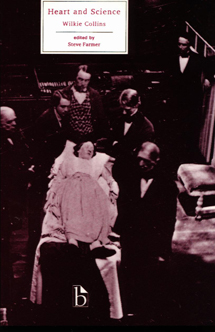
Heart and Science by Wilkie Collins
Heart and Science is my first experience with Wilkie Collins. As a Victorianist, I've been meaning to familiarize myself with this key novelist of the period for some time. Collins is well known for his novels The Woman in White and The Moonstone, where I originally meant to start, but the illustration of Victorian scientific debates in Heart and Science quickly drew my attention. I actually began this novel ages ago (and briefly commented on it in a previous post), but the expiration of my university library privileges meant that I was forced to return the book partially read. Luckily, I was able to acquire a copy from another library, finally allowing me to see this intriguing plot to the end.
The novel revolves around the recently orphaned Carmina Graywell. Raised in Italy, she returns to England where she will be under of the guardianship of her paternal aunt Mrs. Gallilee. Ovid Vere, Mrs. Gallilee's son by a previous marriage, immediately falls in love with his benevolent cousin and the two quickly become engaged. Unbeknownst to Ovid or Carmina, Mrs. Gallilee is on the brink of financial ruin. Dependent on the vast sum of money that is allocated to her while Carmina remains under her care, she maliciously resolves to tear the pair apart through manipulative methods of subterfuge in order to retain access to Carmina's inheritance.
Knowing that the bulk of Wilkie Collins texts are classified as sensation fiction, I was expecting the plot to be more...well, blatantly sensational. True, there are faintings fits and bouts of madness galore. But for the most part, the conflicts between the characters are fought through subtextuality. Mrs. Gallilee will tell the family's governess Miss Minerva A, by which she really means B. Miss Minerva, realizing that Mrs. Gallilee is hinting at B though she says A, will respond with C, by which she really means D. It can render passages of dialogue a bit confusing at times, but the manifestation of such passive-aggressive tension is also very interesting for the reader.
Wilkie Collins
Because Wilkie Collins and Charles Dickens were great friends and colleagues, I idly wondered before diving into Heart and Science if Collins's representation of women would coincide with that of his BFF. As I've expressed before, Dickens's heroines aren't the multi-faceted women I would like to see in fiction. Rather, many of them (e.g., Lucy Manette in A Tale of Two Cities) seem to be an incarnation of his angel-of-the-house fantasy. I'm happy to report that Carmina Graywell didn't fall into that category for me. She is unbelievably kind, continually placing a faith in others that could be foolhardy but instead wins her friends wherever she goes. When the situation calls for it, however, she stands up for herself. She defies Mrs. Gallilee in spite of the threats her aunt employs in an effort to subdue her. But Carmina won't be subdued. She is an illustration of how a Victorian heroine can be traditionally feminine yet strong.
As I mentioned above, I was initially drawn to Heart and Science for its engagement with Victorian science. Vivisection, experimentation on living animals, was widely practiced and hotly debated at the time. Dr. Benjulia, a friend of Mrs. Gallilee's, becomes interested in family affairs as a result of his fixation on brain disease. He also secretly practices vivisection in his laboratory, hoarding an array of unfortunate animals for the purpose. Chapter 32 is a discussion of vivisection, in which Collins carefully inserts many of the arguments against this cruel practice. Benjulia's words on the subject, and why he chooses to indulge in vivisection, are chilling:
Have I no feeling, as you call it? My last experiments on a monkey horrified me. His cries of suffering, his gestures of entreaty, were like the cries and gestures of a child. I would have given the world to put him out of his misery. But I went on. In the glorious cause I went on. My hands turned cold -- my heart ached -- I thought of a child I sometimes play with -- I suffered -- I resisted -- I went on. All for Knowledge! all for Knowledge! (p. 191)
I loved the exploration, one still relevant today, of what we are willing to sacrifice for the advancement of science and technology. Are we paying too great a price?
These analyses aside, Heart and Science is a fast-paced, enjoyable read. It left me eager to explore more of Wilkie Collins's texts as well as sensation fiction by female authors, namely Lady Audley's Secret by Mary Elizabeth Braddon and East Lynne by Ellen Wood. I'm interested to see how the genre is represented by women. Are the generic trends essentially the same, or do they differ based on the gender of the author? If you've read them, I'd love to hear what you think as well as any sensation fiction recommendations!
Labels:
Authors,
Books,
Victorians,
Wilkie Collins
Subscribe to:
Posts (Atom)